
1. How to Choose the Right Trailer for Your Application
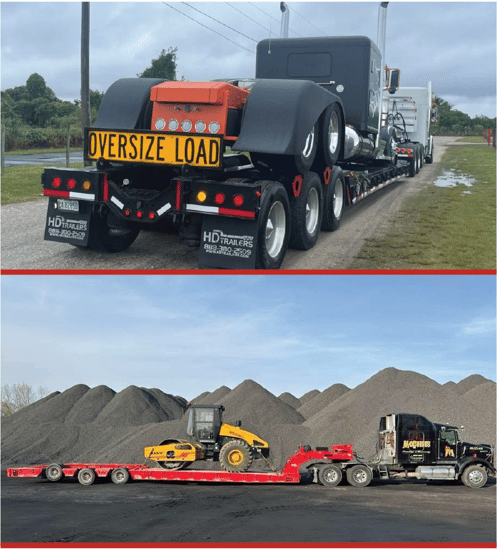
The single most important question in trailer buying isn't "How much does it cost?" It's "What am I hauling?"
That sounds obvious, but the answer drives everything else - axle configuration, deck height, and trailer length. A good dealer will start the conversation here, not with price.
Start With Your Use Case
The first step is identifying what industry you're operating in and what kind of equipment is going on that trailer. Are you in construction, hauling yellow iron - excavators, bulldozers, the heavy stuff? Are you moving municipal equipment like fire trucks or buses? Are you getting into specialized work hauling data center components or oversized loads?
Each of these applications points to a different category of trailer, and sometimes a different configuration entirely.
The Questions That Actually Matter
Once the application is clear, a few qualifying questions will narrow things down fast:
- How much does the equipment weigh? This is what determines your axle configuration. A two-axle trailer handles a very different load range than a three-axle setup. Getting this wrong means you either can't legally load the trailer or you're hauling more trailer than you need.
- How often are you hauling it? A buyer running loads five days a week has very different durability and component requirements than someone hauling once or twice a month. Frequency affects build quality requirements, maintenance cycles, and whether add-ons like tire inflation systems or digital scales justify their cost.
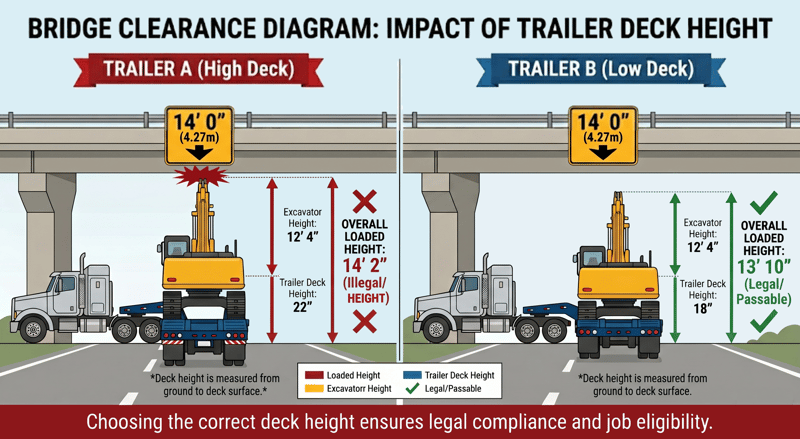
- What are the dimensions - especially height? If you need to stay under 14 feet to clear bridges and stay legal, you need the lowest deck height possible. The difference between an 18-inch deck and a 22-inch deck might sound minor, but those four inches directly determine which loads you can legally carry under bridge laws.
- How long does the trailer need to be? Some loads require a fixed-length well; others need an extendable trailer that can stretch from 34 to 60 feet. And keep in mind that certain states won't let you run longer than 50 feet overall - so your operating territory matters here too.
- Where are you planning to grow? This is the question buyers skip the most, and it leads directly to the most expensive mistakes. If you're scaling into heavier loads within the next year or two, it's far cheaper to buy the right trailer now than to buy short and replace it later.
Know Your Trailer Types
The heavy-haul world has its own vocabulary, and knowing the basics will help you speak the same language as your dealer:
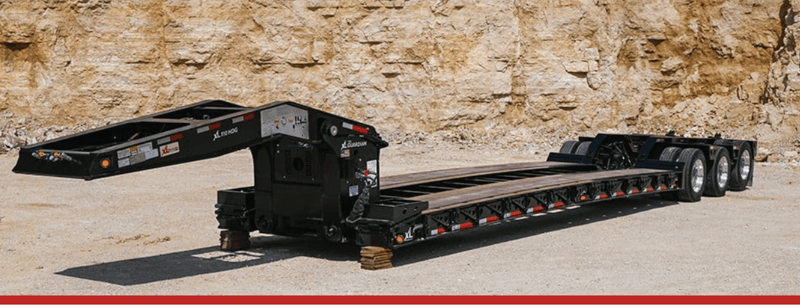
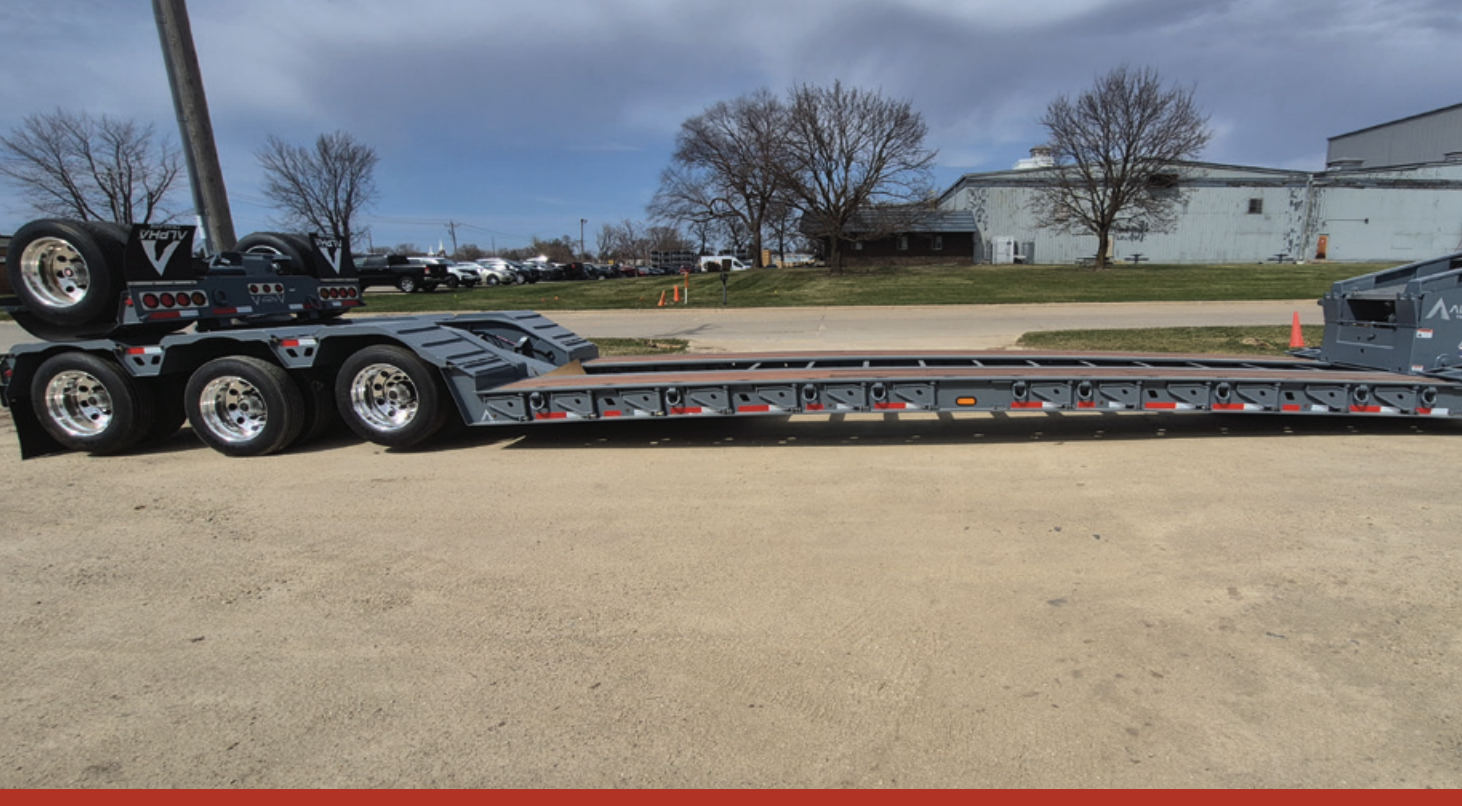
- Lowboy / RGN (Removable Gooseneck): This is the core category for heavy equipment hauling. The detachable gooseneck allows you to drive or load equipment directly onto the deck from the front.
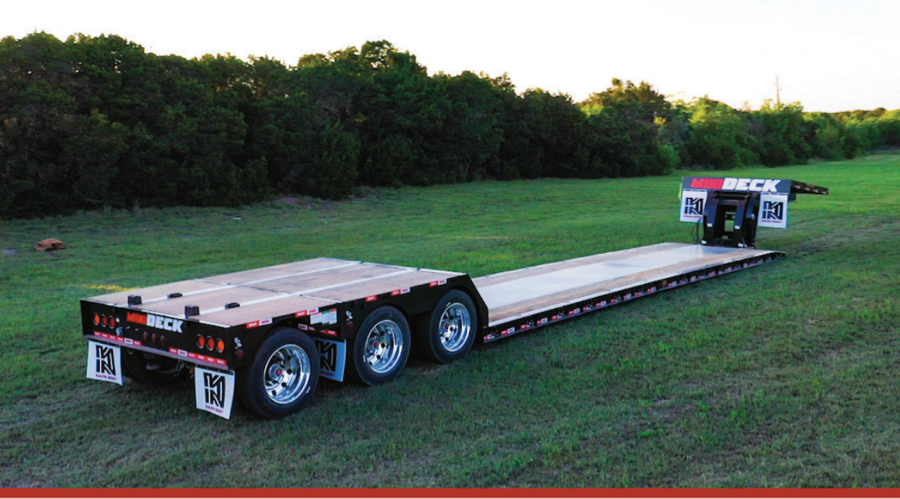
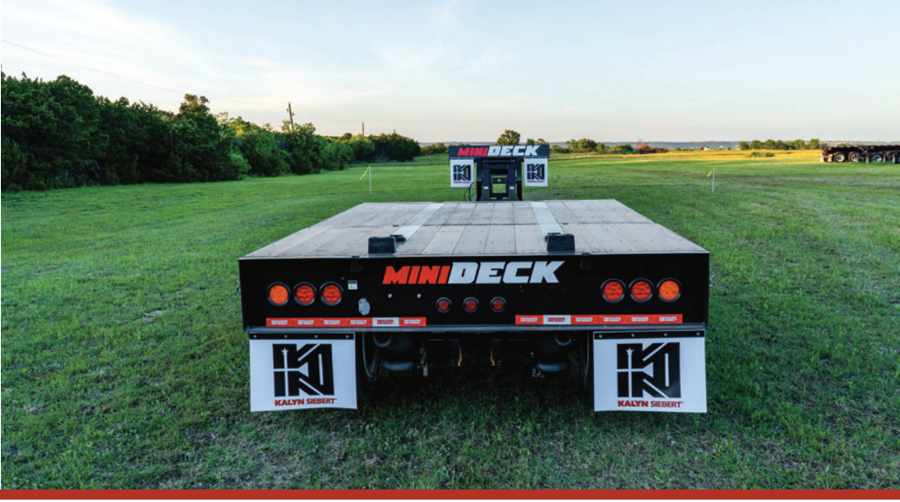
Models range widely, from 35-ton mini-deck configurations with a 12-inch loaded deck height, all the way up to 110,000-lb capacity units with 18-inch decks, three axles, and heavy-duty outriggers.
- Sliding Axle (Landoll-style): These trailers are the go-to for towing low-clearance equipment and containers.
With a low 7-degree approach angle and a deck-mounted winch, they make loading damaged or disabled equipment routine. They're available in 48-, 50-, and 53-foot lengths, and the axle slides underneath to balance the load.
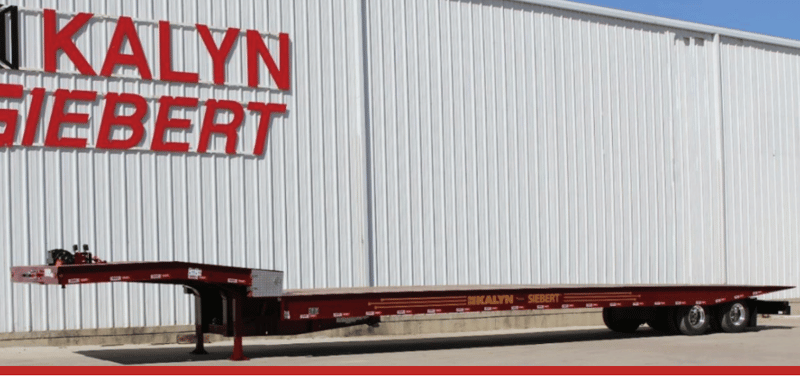
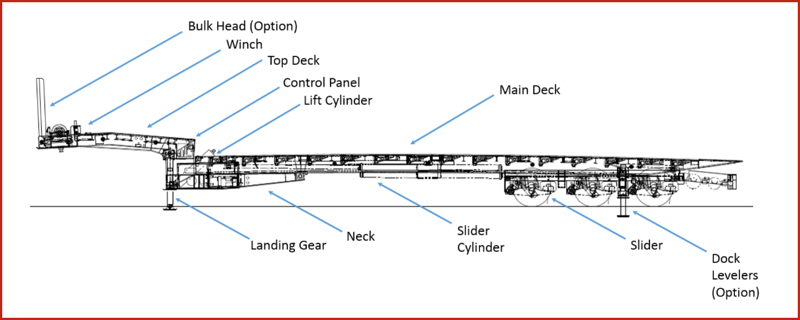
- Specialty and Extendable Configurations: For haulers working in data centers, oversized infrastructure, or unique applications, extendable trailers offer the flexibility to transform from a standard 53-foot length to 58 feet on the fly. Models like the Kalyn Siebert VersaMAXX-EXT are built for exactly this kind of versatility, with 100,000-lb capacity and features like dual 20,000-lb winches with wireless remotes.
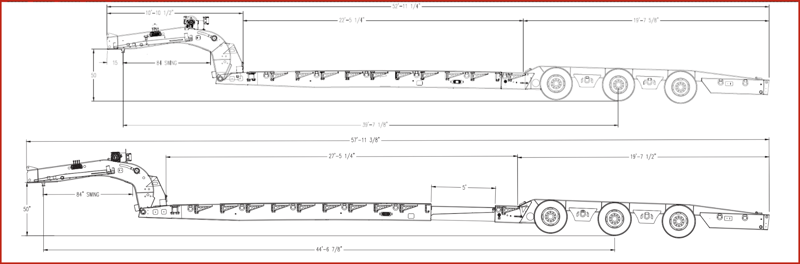
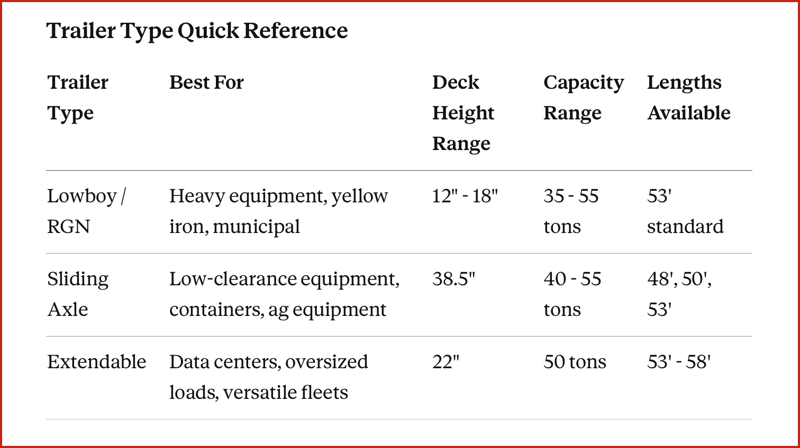
The key takeaway here is simple: the right trailer is not a category decision - it's a use-case decision.

2. Key Specs That Actually Matter (and What Gets Overlooked)
Spec sheets can be intimidating. They're packed with numbers, abbreviations, and component details that might not mean much at first glance. But a few specs drive the majority of your trailer's real-world performance - and a few commonly overlooked details can make or break your operation.
The Specs That Drive Your Business
Axle configuration is arguably the most consequential specification on any heavy-haul trailer. A two-axle, 25,000-lb nominal setup (like you'd find on a 35-ton mini-deck) handles very different work than a three-axle configuration rated for 110,000 lbs distributed. The number of axles determines your legal load capacity, your weight distribution, and your compliance across different states.
Deck height is where many buyers either save money wisely or create problems they'll pay for later. An 18-inch loaded deck height with 6-inch ground clearance gives you access to a wide range of loads while staying legal under bridge height limits. A 22-inch deck height saves you money upfront - but in markets where bridge laws are enforced strictly, those extra 4 inches can eliminate loads you'd otherwise be eligible for. At the other end of the spectrum, a 12-inch mini-deck with 4-inch ground clearance is purpose-built for the tightest height requirements.
Load capacity and concentration ratings tell you not just total weight but how that weight can be distributed. For example, a 110,000-lb capacity trailer might be rated for that full weight in a 12-foot span when configured as a 4-axle setup, or in a 16-foot span as a 3+1 arrangement. Those details matter when you're positioning heavy, concentrated loads.
Trailer length and extendability affects both what you can carry and where you can carry it. A standard 53-foot overall length works in most jurisdictions, but some jobs require the ability to extend to 58 feet or more - and some states restrict overall length to 50 feet.
Weight distribution components - bolsters, outriggers, and chain drops - determine how effectively you can secure and balance a load across the deck. A trailer spec'd with chain drops on 24-inch centers and swing-out outriggers gives you far more flexibility in load positioning than one without. These components also affect legal compliance: improper weight distribution can put you over axle limits even when your total weight is legal.
How Deck Height, Capacity, and Axles Compare Across Real Trailer Models
The table below is built from actual manufacturer spec sheets. This is what the differences look like in practice.
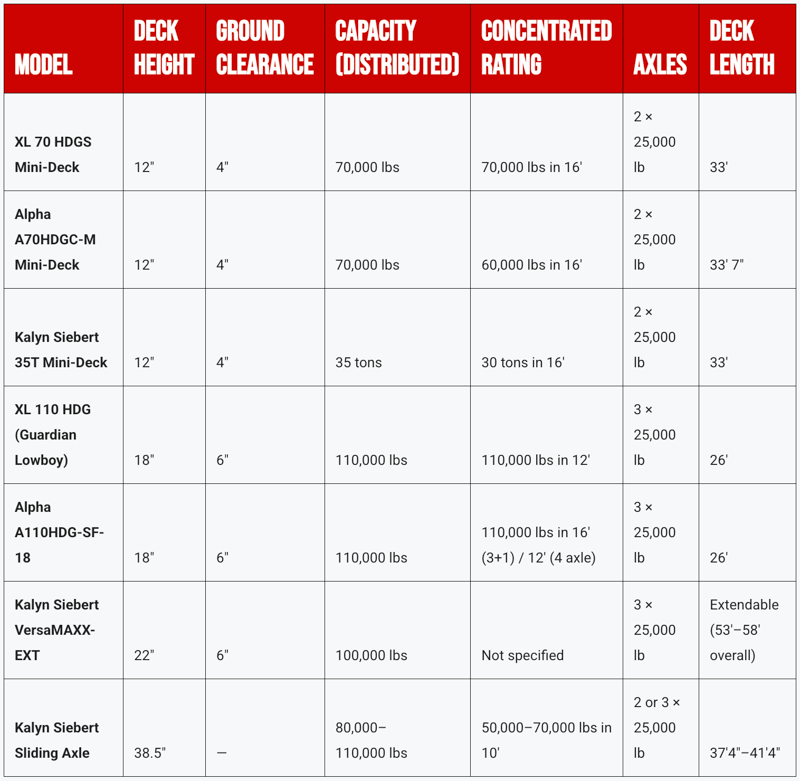
Notice the pattern: lower deck heights pair with shorter deck lengths and different capacity ratings. A 12" mini-deck gives you 33 feet of usable deck. An 18" lowboy gives you 26 feet but handles significantly more weight. The 22" extendable trades deck height for length flexibility. Every configuration is a set of tradeoffs.
What Gets Overlooked
Outriggers are often assumed but not always included. Buyers coming from one trailer type often expect outriggers on every configuration, but many mini-deck trailers don't come standard with them. Always confirm whether outriggers are included in the base spec or listed as an option in the quote.
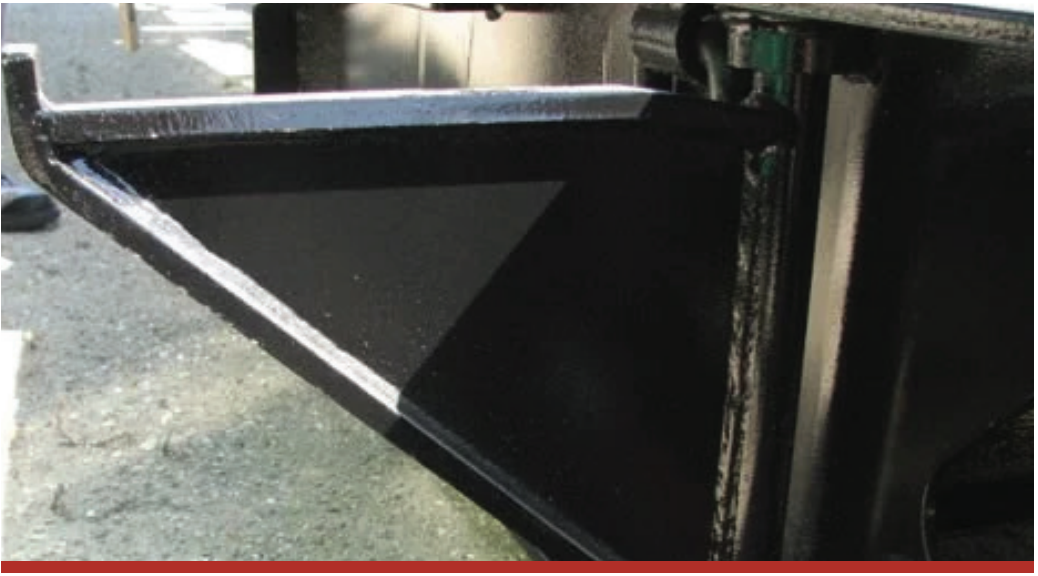
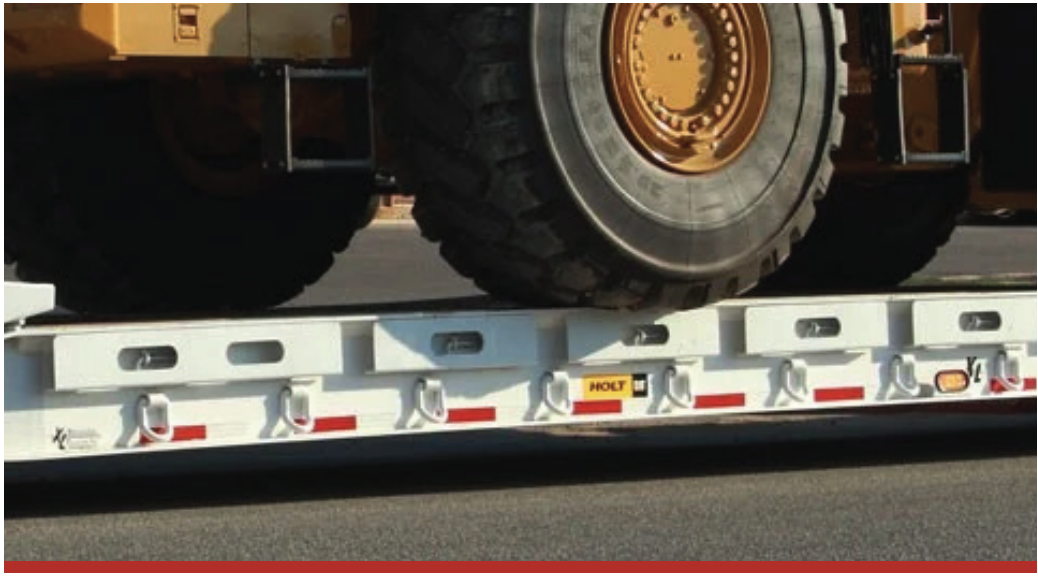
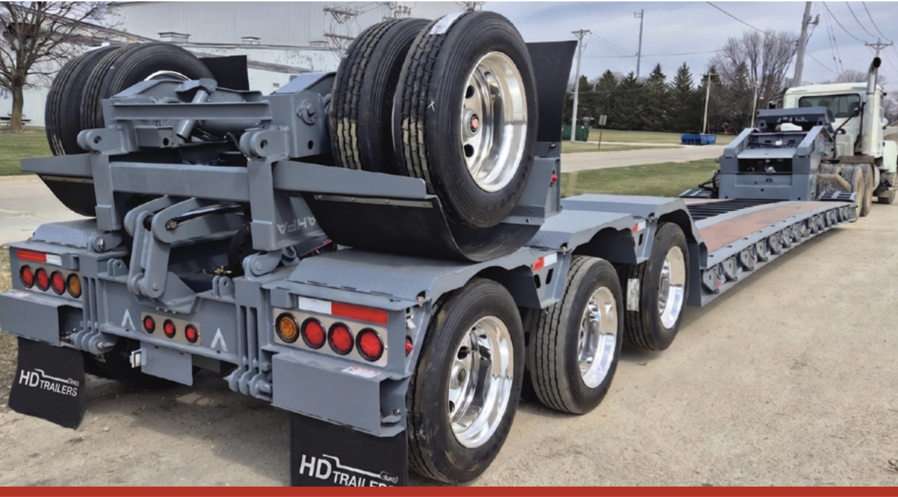
State-specific requirements catch buyers off guard regularly. Spreader bars and axle recognition components aren't optional in certain jurisdictions - they're legal requirements.
In states like Oklahoma, weight limits are tied not just to how many axles you have, but how they are spaced and configured. If your setup doesn’t meet those spacing and bridge formula requirements, the state may not recognize the full capacity of your axle group for permitting.
Requirements also vary by state, so if you operate across state lines, you need to plan for the strictest rules you’ll encounter.
Real-world implication
Remember, small spec differences determine what jobs you can take, whether your loads are legal, and how often you're turning down work.
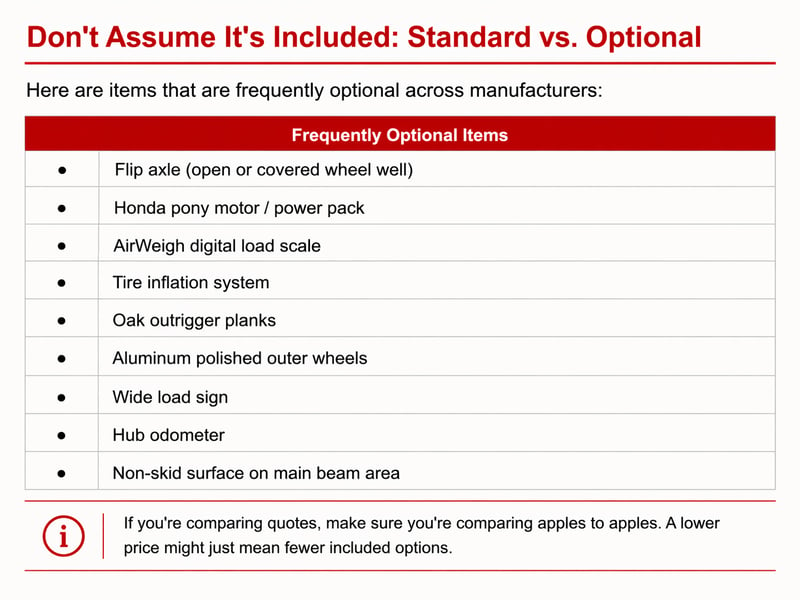
If you're comparing quotes, make sure you're comparing apples to apples. A lower price might just mean fewer included options.
3. Common Buying Mistakes That Cost You Later
Every experienced hauler has a story about the trailer they wish they'd bought differently. Here are the patterns that come up again and again.
Mistake #1: Buying Based on Price Alone
This is the most common and most expensive mistake in the industry. A buyer saves money by going with a two-axle configuration that fits their current loads. It works at first. But as heavier jobs start coming in, they find themselves right at the edge of legal limits or unable to take the load at all. Instead of growing into better-paying work, they’re stuck passing on it. The upfront savings don’t hold up once better jobs are off the table.
Mistake #2: Not Planning for Future Needs
Skipping components like flip axles at purchase time is a classic example. The thinking is always the same: "I don't think I need that right now." But the work almost always catches up. When it does, you're hoping your dealer still has the component in stock. If they don't, you're waiting on a build - and in the meantime, manufacturers may have raised prices. That $25,000 add-on you passed on might now cost you $26,000 or more, plus the revenue you lost while waiting.
Mistake #3: Listening to the Wrong Advice
"My buddy told me this is what I need" is a phrase dealers hear constantly. Well-meaning advice from other haulers doesn't always account for the specifics of your operation - your loads, your routes, your growth plans. The trailer that works perfectly for someone else's business might be entirely wrong for yours.
Mistake #4: Underestimating How Specs Impact Revenue
Height, length, and axle configuration aren't just technical details on a spec sheet. They're the gatekeepers that determine which loads you can legally carry. Every spec decision is a business decision, and the buyers who treat it that way come out ahead.
Mistake #5: Buying Entry-Level Quality Without Understanding the Tradeoffs
There are manufacturers in the market who sell direct and offer significantly lower prices - sometimes $20,000 to $40,000 less for a comparable-looking trailer. But "comparable-looking" is doing a lot of heavy lifting in that sentence.
Lower-cost trailers are often built with different materials, weight profiles, and durability standards. Many buyers who go this route find themselves wanting to trade out within a year or two - and discovering that the resale market isn't kind to budget brands.
4. Understanding Why Trailer Prices Vary So Much
Price variation in this industry confuses a lot of buyers, especially those coming from markets where pricing is more standardized. But once you understand what drives the differences, the numbers start to make a lot more sense.
What You're Actually Paying For
Materials are the foundation. Premium heavy-haul trailers often use high-strength steels, such as T1, in critical load-bearing areas to reduce weight while maintaining strength. This is the highest grade available for this application. Manufacturers using lower-grade steel can offer lower prices, but the tradeoff shows up in durability, weight, and long-term maintenance costs.
Build quality and engineering determine how long the trailer holds up under demanding conditions. Features like 100,000 PSI minimum yield flanges, fabricated I-beams, and heavy-duty crossmember spacing aren't visible from twenty feet away, but they're the difference between a trailer that lasts a decade and one that starts showing problems in year two.
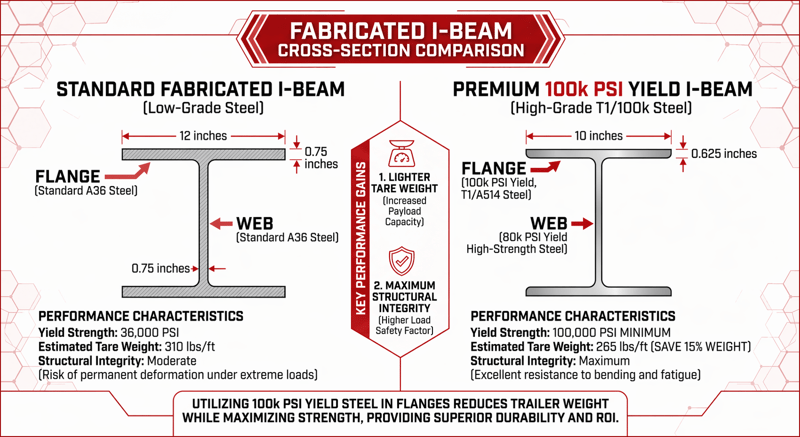
Trailer weight and engineering are directly related to cost. A trailer built to achieve a lower deck height often requires more structure and reinforcement. That added weight drives up the manufacturing cost, but it's also what gives the trailer its structural integrity and load-bearing capability. Budget manufacturers often produce heavier trailers not because of better engineering, but because of less efficient design - and that extra weight eats into your payload capacity without giving you anything in return.
Deck height and configuration complexity directly affect manufacturing cost. Getting a deck down to 12 or 18 inches while maintaining structural integrity requires more sophisticated engineering and heavier-gauge materials. That costs more to build, and the price reflects it.
Components and add-ons - flip axles, outriggers, hydraulic systems, air ride suspension, digital scales, tire inflation systems - all add to the price, but each one adds capability. The question isn't whether they're expensive; it's whether the work you're doing justifies them.
Manufacturer Differences
Not all manufacturers are created equal. Premium manufacturers like Alpha HD Trailers, XL Specialized or Kalyn Siebert or command higher prices because of materials, engineering, and warranty support.
Pricing differences can also be significant even within the same capacity class, depending on materials, engineering, and support. Between the manufacturers that HD Trailers works with - XL Specialized, Alpha HD Trailers, and Kalyn Siebert - you'll see meaningful differences in pricing, but you're staying within a quality tier where the steel, the engineering, and the after-sale support are all strong.
Direct-to-consumer brands occupy a very different space. They can undercut dealer-supported manufacturers by $20,000 to $40,000 on what looks like a comparable trailer. But the savings come with tradeoffs in steel quality, trailer weight, durability, and the support you'll get when something goes wrong. Many buyers who start with a budget brand end up wanting to trade out within a year or two - only to discover that their dealer doesn't work with that manufacturer and can't take it in trade. It's a great way to learn an expensive lesson.
That said, budget trailers aren't always the wrong choice. For someone brand-new to the industry who needs to prove their business model before making a major investment, a lower-cost trailer can serve as an introduction. Run it hard for two or three years, learn what you actually need, and then invest in the right equipment with confidence. Just go in with your eyes open about what you're getting and what you're giving up.
Post-COVID pricing also shifted the landscape. Prices surged roughly 30% during the supply crunch and have since stabilized, but they haven't returned to pre-pandemic levels. Annual increases now tend to be in the 4-5% range - more predictable, but still something to factor into your timeline.
The bottom line: you're not just buying a trailer. You're buying capacity, durability, and access to work.
5. How to Evaluate Manufacturers and Dealers
Once you know what you need, the next question is who to buy it from. This decision is about more than finding the lowest price.
Evaluating the Manufacturer
Reputation matters - and it's specific. Some manufacturers are known for outstanding structural quality but have issues with paint durability or finish work. Others excel across the board but command premium pricing. Do your homework on the specific manufacturer's track record, not just their marketing. Quality issues like poor paint or rust protection aren't just cosmetic - they affect resale value and long-term maintenance costs.
Materials and construction standards should be verifiable. Look for manufacturers using T1 steel, high-yield flanges, and sealed electrical systems. These aren't buzzwords; they're the details that separate a ten-year trailer from a five-year trailer.
Warranty coverage is something every buyer should scrutinize before signing. Most premium manufacturers offer tiered warranties - for example, a five-year prorated frame warranty, three years on paint, and one year on the remainder.
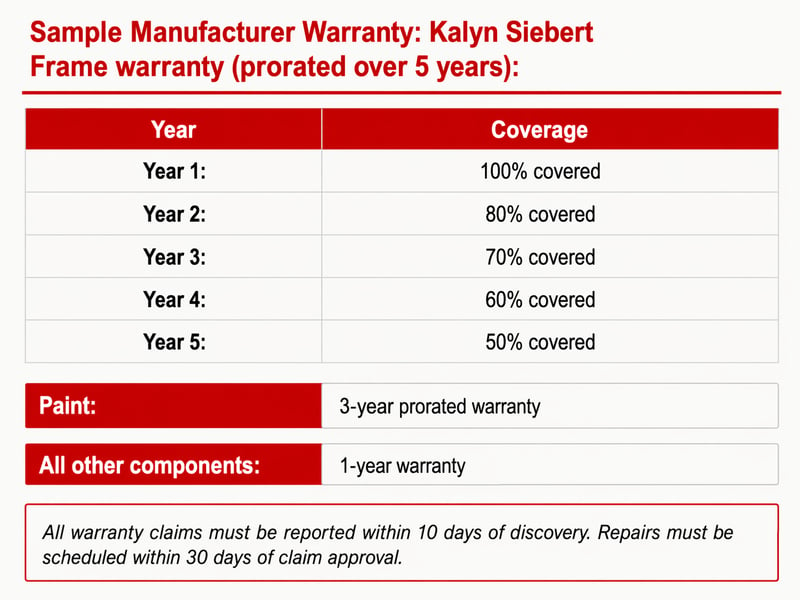
Know exactly what's covered, what's prorated, and what the process looks like if you need to file a claim. Warranty is not an "if" - it's a "when."
Evaluating Dealers
Responsiveness is everything. When your trailer is down, you're losing money every day. A dealer who answers the phone, takes ownership of problems, and moves quickly to resolve issues is worth more than any discount. This is a revenue-generating tool in your toolbox - it needs to be working.
Support after the sale separates good dealers from everyone else. Can they help you source components months after purchase? Will they guide you on spec questions when you're taking on new types of work? Do they maintain inventory so you're not waiting weeks for critical parts?
Guidance, not just sales. The best dealers ask questions before they quote. They want to understand your operation, your routes, your growth plans. If a dealer is pushing you toward a trailer without understanding your application, that's a red flag.
Inventory availability and timing can make or break a deal. A dealer who keeps deep stock means you're not waiting months for a build when you need a trailer now. It also means that when you call back three months later needing that flip axle you skipped at purchase, there's a real chance it's sitting on their lot. Dealers who invest in inventory are investing in their ability to serve you when it counts.
6. Make the Right Decision Before You Request a Quote
The most costly mistakes in trailer buying don't happen at the point of sale. They happen before that - in the assumptions, the shortcuts, and the decisions made without full information. The goal is not just to buy a trailer. The goal is to buy the right tool for your business - one that fits how you actually operate today and where you're headed tomorrow.
That means starting with application, not price. It means understanding how specs like deck height, axle configuration, and trailer length directly impact which jobs you can take. It means planning for growth instead of buying "just enough." And it means working with manufacturers and dealers who earn your trust through knowledge, responsiveness, and honest guidance.
If you're ready to move forward or want guidance specific to your operation, connect directly with HD Trailers. Our team works with you to understand your equipment, your application, and your long-term goals - so you get a trailer that fits how you actually operate. With deep relationships across manufacturers like XL Specialized, Alpha HD Trailers, and Kalyn Siebert, and an inventory that spans lowboys, mini-decks, sliding axle trailers, and specialty configurations, HD Trailers brings the expertise to match the right trailer to your business.
Start the conversation today and get a trailer that fits how you operate.